
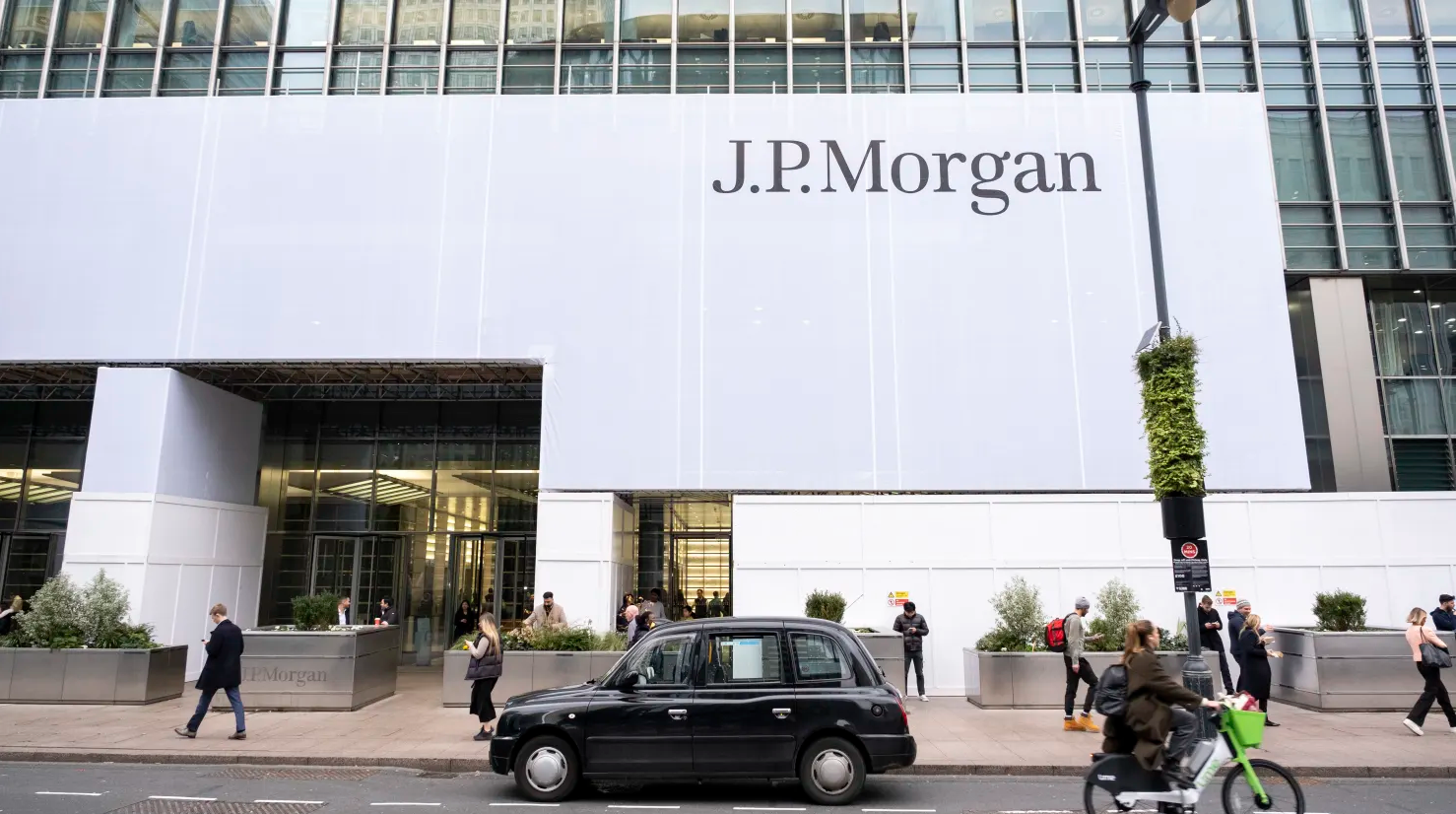
JPMorgan Economic Security Initiative Expands Into Europe
JPMorgan economic security initiative is expanding into Europe with a $1.5 trillion investment aimed at strengthening supply chains, defense, and energy independence.
The JPMorgan economic security initiative moves beyond the U.S., targeting Europe’s defense, energy, and technology sectors to reduce reliance on unstable global supply chains.
The JPMorgan economic security initiative is entering a new phase as JPMorgan Chase pushes its massive $1.5 trillion investment strategy into Europe, signaling a deepening focus on supply chain resilience, defense capabilities, and strategic industries. The expansion comes at a time when geopolitical tensions and economic fragmentation are reshaping how Western economies approach security and growth.
Why the JPMorgan Economic Security Initiative Matters for Global Markets
The move extends the bank’s 10-year Security and Resiliency Initiative, originally launched in the United States, into key European markets. The program is designed to finance and accelerate development in sectors considered vital to national and economic security, including energy independence, advanced manufacturing, artificial intelligence, and defense infrastructure.
At the center of the strategy is a growing concern among policymakers and financial leaders that Western economies have become overly dependent on unstable or politically sensitive sources for critical materials and technologies. Jamie Dimon emphasized that long-term economic strength now depends on rebuilding domestic and allied capabilities across essential industries.
The initiative will prioritize major European economies, including the United Kingdom, France, Germany, Poland, and Italy, while also extending support across broader European Union and NATO-aligned regions. The expansion reflects a coordinated effort to strengthen alliances through economic investment, not just policy alignment.
Strategic Investment Across Critical Industries
Under the expanded JPMorgan economic security initiative, funding will be directed into dozens of subsectors, ranging from aerospace and cybersecurity to nuclear energy and semiconductor production. These industries are increasingly viewed as foundational to both economic competitiveness and national defense.
European defense and aerospace companies have already experienced a surge in investor interest, driven by rising military spending and renewed commitments from NATO members. The sector’s growth underscores a broader shift toward self-reliance, as governments and corporations work to secure supply chains and reduce vulnerabilities.
The initiative is expected to complement existing momentum in Europe’s industrial base, where companies are scaling operations amid record demand. By aligning capital with strategic priorities, JPMorgan aims to accelerate this transformation while positioning itself at the center of long-term structural growth.
Context / Background
The expansion comes against a backdrop of increasing global uncertainty, where disruptions to energy supplies, semiconductor shortages, and geopolitical conflicts have exposed weaknesses in international trade networks. Western economies, particularly in Europe, have faced mounting pressure to localize production and diversify sourcing.
The United Kingdom, for instance, continues to rely heavily on imported energy, while semiconductor supply chains remain concentrated in East Asia. These dependencies have heightened concerns about economic resilience, especially during periods of geopolitical instability.
The JPMorgan economic security initiative seeks to address these challenges by channeling capital into domestic and allied production capabilities, effectively reshaping how critical industries are financed and developed.
Expert Insights
Chuka Umunna, who is leading the initiative in the U.K., described the strategy as a necessary shift in how the West approaches economic security. He highlighted that long-term stability depends not only on financial strength but also on the ability to produce and control essential resources.
Official data shows that energy dependency remains a structural challenge, with countries like the U.K. still relying heavily on imports to meet domestic demand. Full report: Reports
Aerospace giant Airbus continues to play a key role in Europe’s industrial and defense ecosystem, with its stock performance reflecting broader sector growth.
Rolls-Royce has also seen renewed investor interest as defense and energy investments accelerate across Europe.
Financial markets have remained cautious amid rising geopolitical and economic risks, with equities showing mixed performance in recent sessions. Investors continue to monitor central bank signals closely, as highlighted in the latest stock market movements.
According to Umunna, the initiative reflects a broader realization that economic resilience is inseparable from national security. By investing directly in strategic sectors, JPMorgan is aiming to reduce exposure to external shocks while supporting sustainable growth across allied economies.
Industry analysts also note that financial institutions are increasingly playing a direct role in shaping industrial policy, particularly as governments seek private-sector partnerships to fund large-scale infrastructure and technological development.
Public and Market Reaction
Market response to the expansion has been broadly positive, particularly within Europe’s defense and industrial sectors, where increased capital flows are expected to drive further growth. Investors view the initiative as a signal that large financial institutions are aligning with long-term geopolitical and economic trends.
At the same time, some observers caution that execution will be critical. Scaling domestic production in areas like semiconductors and energy infrastructure requires significant time, regulatory coordination, and sustained investment.
Public discourse has also reflected growing awareness of economic security issues, with increasing support for policies that prioritize resilience over short-term efficiency.
Conclusion
The expansion of the JPMorgan economic security initiative into Europe marks a significant shift in how global finance intersects with geopolitics. By committing substantial capital to critical industries, the bank is positioning itself at the forefront of a structural transformation in the global economy.
As supply chain risks, energy challenges, and technological competition continue to intensify, initiatives like this are likely to play a defining role in shaping the next decade of economic growth. The success of the strategy will ultimately depend on its ability to translate investment into tangible resilience, not just financial returns.